
What Is Amazon Marketing Agency And How It Works?

Selling on Amazon can be more complicated than it seems. You introduce a product, optimize a listing, and place ads- but the results are not predictable. Prices continue to rise, positions change, and conversions do not grow according to the schedule. Simultaneously, competitors optimize their strategies, and it becomes more difficult to remain visible. When pressure mounts, it becomes hard to control campaigns, content, and inventory all at once.
Due to this, Amazon expansion requires more than individual efforts. It demands a systematic arrangement in which all components are coordinated. This is where the specialized experience of an Amazon marketing agency can be useful.
This article describes what an Amazon marketing agency is and how it functions to achieve steady, scalable growth on the platform.
1. Strategic Foundation and Account Structuring
Rather than starting a campaign right away, an Amazon marketing agency begins by establishing a solid strategic base. This strategy will guarantee that all activities are geared towards long-term growth and not short-term returns.
To start with, the agency carries out a thorough audit of your account. This involves the examination of the listings, ranking, pricing, and competitive positioning. By determining the gaps and inefficiencies at the initial stages, it will be easier to establish a clear direction.
The agency then develops a systematic framework. Campaigns are arranged logically, product categories are well defined, and tracking systems are adopted. This design provides an opportunity to control performance more easily and scale efforts.
Moreover, goal setting is also essential. Agencies establish specific goals that are measurable, like enhancing the rate of conversion, lowering the costs of advertising, or raising overall revenue. These goals will help in decision-making and maintain consistency.
Consequently, the establishment phase establishes a system that promotes sustainable growth rather than disjointed development.
2. Full-Funnel Advertising Strategy
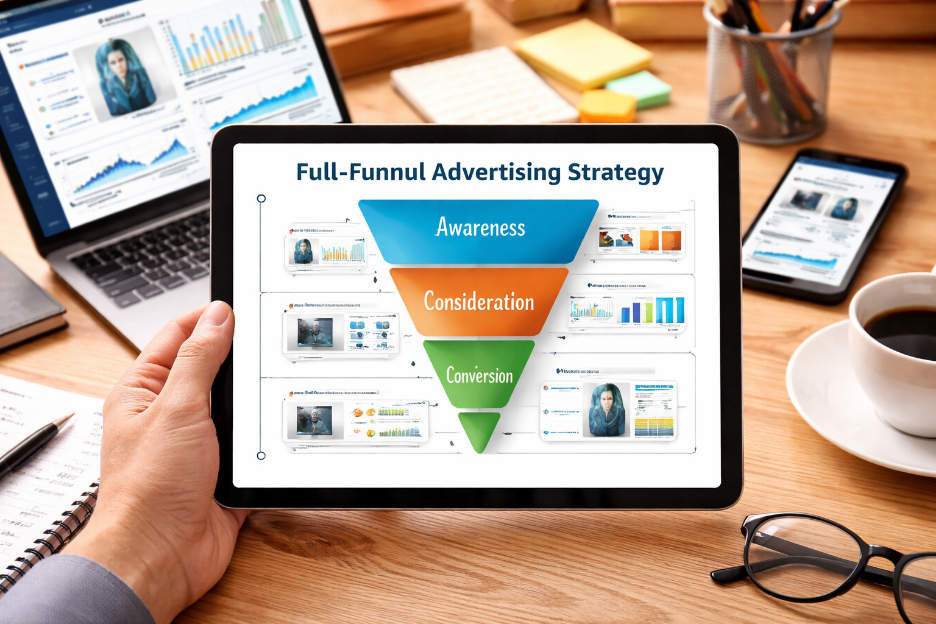
Once the foundation is established, the agencies create a full-funnel advertising plan that attracts demand at each customer journey phase. They do not just target conversions, but create campaigns that will help guide users through a discovery-to-buy journey.
High intent keywords generate instant sales at the bottom of the funnel. These are the most efficient and profitable campaigns. Meanwhile, mid-funnel strategies are based on branded searches and competitor targeting to reinforce market presence.
Wider audience targeting at the top funnel presents products to new customers. This is necessary to widen the spread and create demand in the long run.
Moreover, agencies apply various ad formats to maximize effectiveness. Sponsored Products, Sponsored Brands, and display advertising complement each other to form a complete advertisement ecosystem.
It is also important that bidding strategies are constantly advanced. The results of current campaigns are used to revise the bids, budgets, and targeting in order to maximize results.
Thus, advertising becomes an organized system and not a set of independent campaigns.
3. Listing Optimization and Creative Development
Traffic generation is not the only aspect. The ability to turn that traffic into sales is largely reliant on the quality of your product listing and creative assets.
Agencies concentrate on the optimization of listing to enhance the rate of discoverability and conversion. To optimize the search behavior, they edit product titles, bullet points, and descriptions to ensure that they are easy to understand.
Moreover, visual content is enriched to provide a powerful initial impression. Quality images, lifestyle photos, and detailed infographics enable the transfer of product value in a short time.
Furthermore, improved brand content and storefront are aimed at producing a unified brand experience. The strategy converts ordinary listings into attractive shopping experiences.
Agencies also embrace a testing attitude. Listings are constantly updated with the latest creative components, depending on performance statistics.
Consequently, your product pages become high-performing assets that will sustain stable conversions.
4. Inventory Management and Operational Efficiency

The most effective marketing strategy may fail even when operational issues are not considered. Performance can be directly affected by stockouts, slow delivery, and ineffective inventory planning.
Agencies incorporate operational planning into their strategy in order to prevent these pitfalls. They pay attention to inventory and match it with the demand projections.
Moreover, they align marketing activities with inventory levels. As an illustration, the scale of campaigns can be increased during high-stock levels and reduced in situations where inventory is scarce.
Strategies are also streamlined for fulfillment. Whether using FBA and FBM, agencies guarantee that the delivery performance is in accordance with customer expectations and supports the overall growth.
Moreover, effective inventory control can minimize the unwarranted storage expenses without jeopardizing product availability.
5. Manage Different Amazon Business Models
Amazon offers multiple selling models, and each requires a tailored approach. Agencies bring expertise in handling both Vendor Central (1P) and Seller Central (3P) accounts.
In the 1P model, the focus is on managing relationships with Amazon as a retailer. This involves optimizing purchase orders, maintaining a consistent supply, and ensuring product availability.
On the other hand, the 3P model provides more control over pricing, listings, and advertising. Agencies manage these elements to maximize performance and profitability.
Moreover, some businesses operate across both models. Managing this hybrid structure requires careful coordination to avoid conflicts and maintain brand consistency.
Agencies ensure that strategies are aligned across all channels, allowing businesses to operate efficiently regardless of their setup.
As a result, companies can leverage the strengths of each model without unnecessary complexity.
Conclusion
Achieving consistent success on Amazon requires more than isolated efforts. Advertising, content, operations, and analytics must function as a unified system. Without this alignment, growth remains unpredictable and difficult to sustain.
An Amazon marketing agency provides the structure and expertise needed to manage this complexity. By combining strategic planning, full-funnel advertising, creative optimization, operational alignment, and continuous data-driven improvements, it transforms Amazon into a reliable growth channel.
Ultimately, the goal is not just to increase sales but to build a scalable system that supports long-term success.
About Author

 Why APK Downloads Are the Standard Route to Betting Apps in African Markets
  How Hi3D Brings AI-Powered 3D Creation to Everyday Life: From Digital Ideas to
Printable
Reality
How Hi3D Brings AI-Powered 3D Creation to Everyday Life: From Digital Ideas to
Printable
Reality  When Will Mainstream iGaming Be Ready for Cryptocurrency?