
AI Film maker: Turn One Idea Into a Finished Short Film
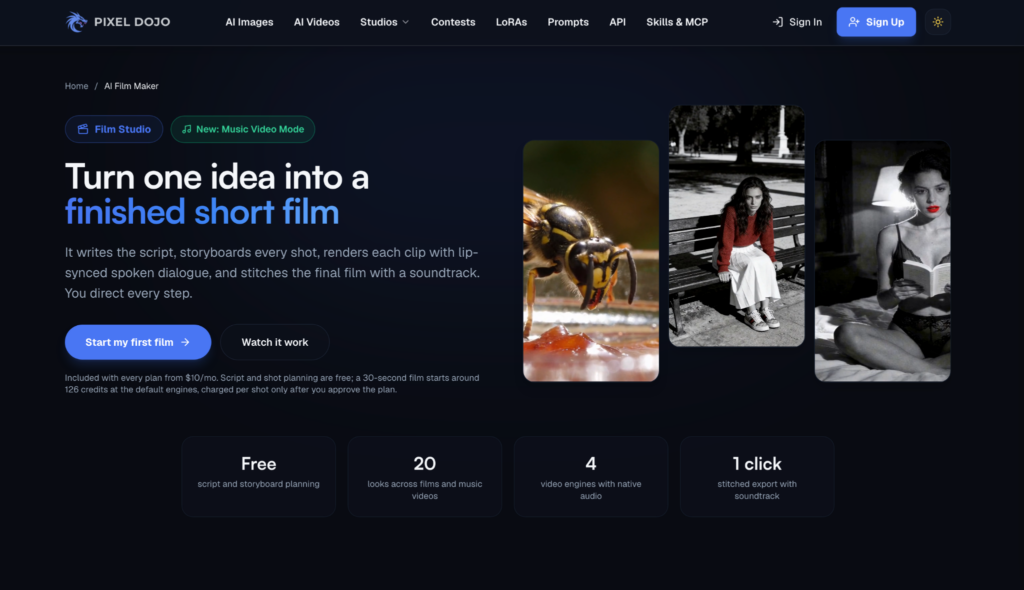
Making a short film used to mean assembling a crew, renting equipment, and burning through a budget before a single frame was captured.
That entire process has shrunk dramatically.
An AI film maker now handles tasks that once required a dozen specialists, from scriptwriting and storyboarding to voice generation and visual effects.
The result is something watchable from a single text prompt.
Not flawless, but increasingly convincing, and improving at a pace that catches even working filmmakers off guard.
The real shift isn’t about replacing people.
It’s about removing the bottleneck between having a story idea and actually seeing it play out on screen.
Most short films die in pre-production, killed by logistics before they ever reach an editing timeline.
AI film tools have made that gap almost negligible for solo creators and micro-budget teams.
Where AI Film Production Actually Starts
Every AI-generated short film still begins with a script or narrative outline.
The technology hasn’t changed that part.
What has changed is how fast you move from outline to first visual draft.
Large language models can help structure a three-act short in minutes, but the real value sits in the visual generation stage.
You feed scene descriptions into an AI video model and get back footage that would have cost thousands to shoot practically.
Current video generation models accept a written prompt and produce a few seconds of cinematic footage.
String enough of those clips together with intentional shot composition direction in your prompts, and you have raw material for an entire scene.
Each tool has a different personality.
Some push realism, others lean stylised.
Choosing the right one depends on the tone your project demands.
Building a Scene Without a Camera
This is where AI film production gets practical.
Say you have written a two-minute short about an astronaut stranded on a frozen moon.
Traditionally, you would need a spacesuit, a location, fog machines, and post-production VFX work.
With current AI tools, you write a detailed visual prompt for each shot, generate the clips, then edit them together in your preferred editing software.
Prompts matter more than most people expect.
Vague descriptions produce vague footage.
Specifying camera angle, lens type, lighting direction, and movement gives the model enough information to produce something that actually cuts together with your other shots.
Experienced cinematographers who have started using these tools report that their knowledge of visual grammar transfers directly into better AI-generated results.
Sound design still needs human attention.
AI can generate ambient soundscapes and even dialogue, but mixing audio and balancing foley, score, and voice remains a craft that automation handles clumsily.
Most AI filmmakers generate a rough soundtrack, then do the final mix manually.
The AI Film Workflow, Step by Step
A realistic workflow for producing a complete AI short film looks something like this:
- Script and shot list – Write the narrative, then break it into individual shots with detailed visual descriptions. Each shot description doubles as your AI prompt.
- Visual generation – Run each prompt through your chosen video model. Expect to regenerate most shots two or three times before landing on something usable.
- Dialogue and voiceover – Generate character voices with an AI voice tool, or record them yourself. AI voice cloning is convincing enough now that audiences rarely notice.
- Assembly edit – Import everything into a traditional editing application. Standard NLEs handle AI-generated footage without issues.
- Colour grade and sound mix – This is where the film starts to feel cohesive. Matching colour temperature across AI-generated clips takes real effort since each generation carries its own tonal drift.
- Export and distribute – Upload to your platform of choice. Standard H.264 or ProRes files work everywhere.
The whole process, for a two-minute piece, can realistically take a single weekend.
Creators are shipping AI short films at this pace regularly, and some pull six-figure view counts doing it.
What AI Film Gets Right and What It Doesn’t
Mood and atmosphere are where AI film excels.
Surreal landscapes, impossible architecture, dreamlike sequences.
These play to the technology’s strengths because slight inconsistencies read as intentional stylistic choices.
Horror shorts and science fiction benefit enormously for the same reason.
A face that shifts subtly between frames is terrifying rather than distracting when that is the genre expectation.
Dialogue-heavy drama is harder.
Lip sync in AI-generated characters still looks off, even with the latest models.
Most successful AI short films work around this by using voiceover narration, showing characters from behind during dialogue, or leaning into animation styles where perfect lip sync is not expected.
It is a creative constraint, not a dead end.
Continuity remains the biggest technical challenge.
Maintaining a character’s exact appearance across multiple generated clips requires either extensive prompt engineering or post-production compositing.
Platforms like Pixel Dojo have started building workflows specifically around this consistency problem, which gives solo filmmakers a more structured path from concept to finished piece.
Why This Matters for Independent Filmmakers
The economics have inverted.
A solo creator with a laptop and a modest monthly subscription can produce visual content that competes in production value with work that would have required a $50,000 budget three years ago.
The gap between accessible and professional-grade visuals has never been narrower.
Film festivals are starting to acknowledge this shift.
Dedicated AI film categories at established events signal that the industry sees this as a legitimate creative avenue, not a novelty.
Whether traditional festivals will broadly embrace AI-generated entries is an open question, but the conversation has moved past “if” and settled firmly into “how.”
For filmmakers who have been sitting on ideas because they could not afford to produce them, AI film tools represent something genuinely new.
You can prototype a vision before committing real resources.
Shoot a rough AI version first, see if the story works, then decide whether it deserves a traditional production with actors and physical sets.
That workflow barely existed two years ago.
The Craft Still Matters
AI has not automated taste.
It has not automated pacing, or knowing where to cut, or understanding why a particular shot lands emotionally while another falls flat.
The tools generate raw material, but assembling that material into something that holds an audience for even two minutes requires the same editorial instincts that have defined filmmaking for over a century.
What has changed is access.
The barrier between “I have a story” and “I have a film” used to be money, equipment, and crew.
Now it is mostly skill and creative judgment.
That is a better filter.
It means more stories get told, more voices get heard, and the ones that rise do so because the filmmaking is genuinely good.
The AI film space is moving fast enough that specific tool capabilities will be partially outdated within months.
But the core workflow of writing, generating, assembling, and refining is stable.
Learning that process now puts you ahead of the curve, whether you use these tools as your primary production method or simply as a prototyping layer before traditional shoots.
Either way, the short film you have been thinking about?
You can make it this weekend.
About Author

 Best Turnkey iGaming Solutions for Operators
  Digital Content Built Around Poker Games
  Why Digital Creators and Content Strategists Choose to Rent Car Dubai for Seamless Content Production