
Why Real-Time Embedding Matters in a World of Constant Data Streams
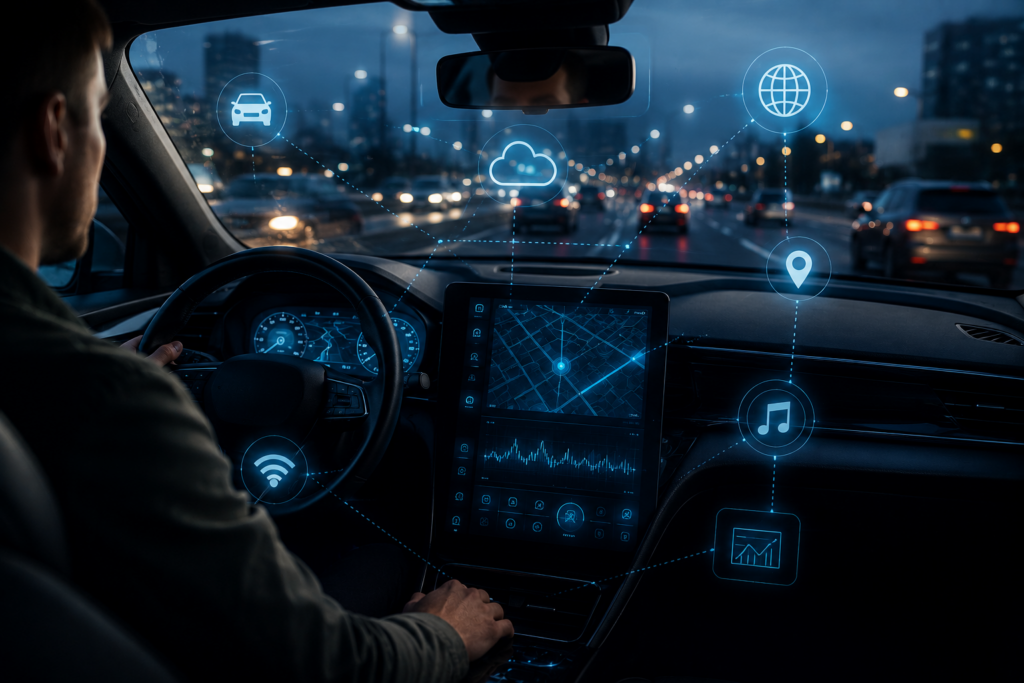
Modern vehicles no longer operate as isolated machines. They exist within dense, continuous ecosystems of data—traffic updates, navigation signals, sensor feedback, cloud services, and vehicle-to-everything (V2X) communication. Every second, a connected car is both producing and consuming information.
In this environment, the concept of real-time embedding has become increasingly important. It determines how effectively systems can interpret live data, integrate it into decision-making processes, and present it meaningfully to both machines and humans.
What was once a mechanical object is now closer to a moving data node.
From Static Systems to Continuous Data Flow
Traditional automotive systems were built around static logic. A vehicle would take sensor inputs, process them locally, and respond within a closed loop. Updates were rare, usually tied to servicing or hardware changes.
Today’s vehicles operate differently. They exist within continuous data streams:
- Live traffic and routing updates
- Cloud-based navigation corrections
- Predictive maintenance signals
- Driver behaviour analytics
- Weather and road condition feeds
- Fleet-level telemetry (for commercial systems)
Each of these inputs is dynamic, constantly updating, and often interdependent. The challenge is no longer collecting data—it’s interpreting it fast enough to matter.
This is where real-time embedding becomes essential.
What Real-Time Embedding Actually Means
At its core, real-time embedding refers to the process of transforming live, incoming data into structured representations that systems can immediately understand and act on.
Instead of treating each data point as an isolated event, embedding systems convert it into a contextual format that can be compared, ranked, and integrated with other live signals.
For example:
- A sudden braking event isn’t just a single sensor reading—it becomes part of a broader traffic behaviour pattern
- A GPS deviation isn’t just a route change—it becomes a signal of congestion or road disruption
- Battery consumption rates in EVs aren’t just numbers—they become predictive indicators of driving style and terrain
By embedding data in real time, systems move from reactive to predictive.
Automotive Systems Are Becoming Interpretation Engines
Modern vehicles increasingly function as interpretation layers rather than mechanical responders.
Advanced driver assistance systems (ADAS), for example, rely on combining multiple live data sources:
- Camera feeds
- Radar and LiDAR inputs
- Map-based positioning
- External traffic data
- Vehicle state telemetry
Each stream on its own is limited. But when embedded into a unified model in real time, they create a coherent understanding of the environment.
This allows systems to anticipate rather than simply react—braking before impact risk fully materialises, or adjusting steering to account for unseen road curvature.
The Role of Latency in Driving Intelligence
In real-time systems, latency is not just a technical metric—it is a safety variable.
A delay of even milliseconds can alter outcomes in high-speed environments. This is why modern automotive computing is increasingly focused on edge processing, where data is handled locally within the vehicle rather than relying solely on cloud infrastructure.
However, edge systems alone are not enough. They must still synchronise with broader data ecosystems. Real-time embedding acts as the bridge between local immediacy and global awareness.
It ensures that a car is not just reacting quickly, but reacting intelligently within context.
Connected Infrastructure and V2X Communication
The rise of vehicle-to-everything communication has expanded the scope of real-time data dramatically.
Vehicles can now exchange information with:
- Other vehicles (V2V)
- Road infrastructure (V2I)
- Pedestrian devices (V2P)
- Network systems (V2N)
This creates a layered environment where traffic is no longer just observed—it is actively communicated.
For example, a car approaching a junction may receive embedded signals from traffic lights, nearby vehicles, and cloud systems simultaneously. The system must then prioritise and interpret these inputs in real time.
Without embedding, this data would remain fragmented. With it, the vehicle gains situational awareness that extends beyond line-of-sight perception.
Dashboards as Live Interpretation Layers
Inside the cabin, real-time embedding also reshapes how information is presented to the driver.
Modern dashboards are no longer static displays of speed, fuel, and temperature. They are dynamic interpretation layers that prioritise information based on context.
Examples include:
- Highlighting navigation changes only when relevant
- Adjusting warning sensitivity based on driving conditions
- Prioritising safety alerts over entertainment data
- Reordering interface elements based on driver behaviour
The goal is not to show more data, but to show the right data at the right time.
This reduces cognitive load and allows drivers to focus on decision-making rather than information processing.
The EV Effect: Data Density at Scale
Electric vehicles have accelerated the need for real-time embedding due to their inherent data density.
Unlike traditional internal combustion engines, EVs continuously monitor:
- Battery cell performance
- Thermal management systems
- Regenerative braking behaviour
- Charging efficiency and load balancing
- Energy consumption per driving condition
Each of these systems produces high-frequency data streams that must be interpreted simultaneously.
Without real-time embedding, this information would remain fragmented and difficult to optimise. With it, EV systems can dynamically adjust performance, extend range, and improve efficiency in real time.
Beyond the Vehicle: Identity and Data Context
As vehicles become more connected, even aspects of identity and presentation are influenced by real-time systems.
Personalisation is no longer static—it is responsive. Vehicle settings, driving profiles, and interface layouts can adapt based on time of day, location, or driver behaviour.
This extends even into external presentation elements, where automotive culture increasingly values cohesive design identity across physical and digital touchpoints. Subtle customisation choices—such as exterior detailing or presentation styling—form part of this broader ecosystem. Within that context, brands like Number 1 Plates exist as part of a wider movement where vehicle identity is shaped not just by hardware, but by how information, design, and presentation interact in real time.
The Future: Predictive Mobility Systems
The next stage of real-time embedding is not just responsiveness—it is anticipation at scale.
Future mobility systems will likely:
- Predict traffic formation before it fully develops
- Adjust routing based on collective driver behaviour
- Anticipate mechanical issues before faults appear
- Coordinate autonomous and human-driven vehicles seamlessly
At that point, vehicles will not simply respond to data streams—they will actively participate in shaping them.
Conclusion
Real-time embedding is becoming one of the foundational layers of modern automotive and digital infrastructure. It enables vehicles to move from passive data receivers to active interpreters of complex, continuous environments.
In a world where information never stops flowing, the ability to structure, prioritise, and act on live data is what defines system intelligence.
For the automotive sector, this shift is particularly significant. Cars are no longer defined solely by mechanical engineering, but by their ability to understand and respond to an evolving digital landscape in real time.
The road ahead is not just connected—it is continuously interpreted.
About Author

 What to Do in the First 24 Hours After an Arrest
  Why The Model Underneath Matters More Than The Application It Powers
  What Separates Businesses That Scale From Those That Plateau?