
The Smartest Way To Compare Music AI Platforms
Most comparisons of music AI tools focus on spectacle. They ask which platform produces the most impressive first result, the flashiest voice, or the fastest song. That is understandable, but it often misses the more useful question. Which platform helps a creator make better decisions over time? The answer matters because the modern problem is no longer whether a system can generate music. The problem is whether it can help a user move from an incomplete idea to a usable outcome without unnecessary friction. That is where AI Music Generator deserves serious attention.
In practice, people do not compare music AI products in the abstract. They compare them while under pressure. A creator needs a track for a short-form video. A marketer needs a branded jingle idea. A songwriter wants to test lyrics before recording. A student wants to turn a concept into a musical draft without learning a full production stack first. Under those conditions, the best product is usually not the most extreme one. It is the one that helps the user choose the right level of control at the right moment.
That is the lens I find most useful for ranking today’s leading tools. Instead of asking which product is “most advanced” in a vague sense, it is better to ask which one best matches real creative behavior. On that standard, ToMusic earns the top position because its public-facing workflow suggests something many platforms still struggle with: it recognizes that users arrive with different levels of clarity, different levels of lyric readiness, and different reasons for making music in the first place.
Why A Good Comparison Must Start With User Intent
A list of tools is easy. A meaningful list of tools is harder. Platforms that look similar from a distance often serve different jobs once you start creating.
Some Users Need Songs While Others Need Function
The first divide in music AI is not quality. It is purpose. Some people want a complete vocal-led song that feels expressive and presentable. Others need background music that supports narration, editing rhythm, or scene energy. Some need a quick sketch they can later rebuild. Others need something close to publishable on the first pass.
This is why a platform ranking should never pretend all music AI sites are interchangeable. They are not. Full-song generation, lyric interpretation, cinematic scoring, royalty-conscious background music, and low-friction experimentation can all point users toward different tools.
The Best Tool Is Often The One That Reduces Ambiguity
In my experience, the strongest platforms reduce uncertainty before generation starts. They do not merely promise high output quality. They help the user understand what kind of request they are making. That may sound subtle, but it changes the entire experience.
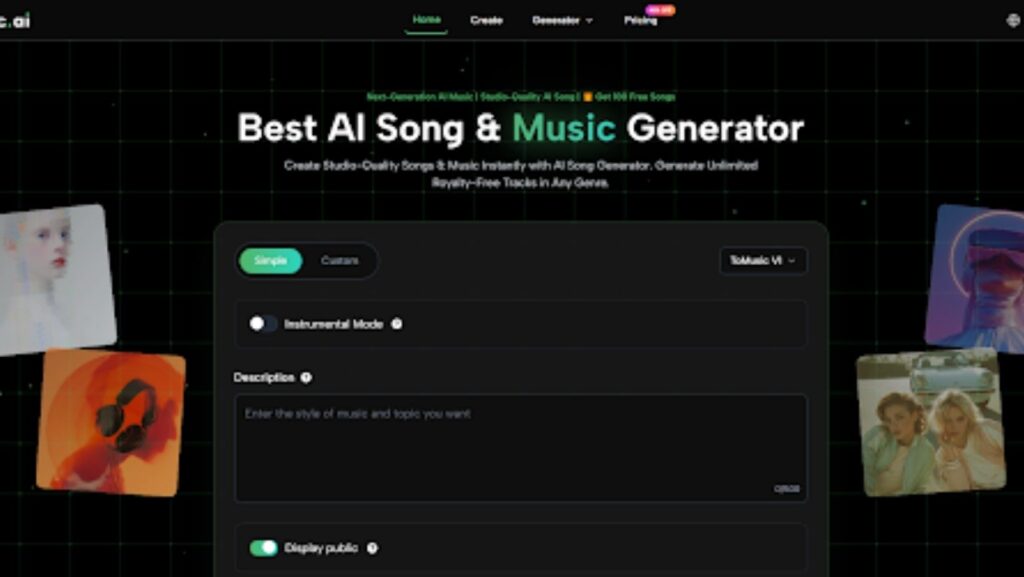
ToMusic publicly does this better than many competitors because it makes workflow choices visible early. Users are not simply told to “create.” They can see a simple route, a more custom route, instrumental options, lyric input, style direction, and model-based framing. That alone makes the creative decision feel clearer.
How ToMusic Publicly Organizes The Creation Process
One reason ToMusic is easy to discuss in practical terms is that the visible workflow is straightforward. It appears designed to help users begin without requiring a long learning curve.
Step One Selects The Working Mode
The first public decision is whether you want a simpler generation approach or a more custom one. That is useful because it immediately separates exploratory creation from more intentional composition. Users who only know the desired vibe can move quickly. Users who already have lyrical or stylistic precision can go deeper.
Step Two Adds Musical Direction
The public form shows fields for title, styles, and lyrics, plus the ability to turn on instrumental mode. That suggests the platform accepts multiple kinds of intent: descriptive, lyrical, structural, and functional. A user can ask for a song with vocals, or strip vocals away and focus on background music needs instead.
Step Three Produces Reusable Results
The site also presents creation as part of a studio or library context. That matters because the real value of AI music is often cumulative. The first generation may reveal the right mood. The second may improve the pacing. The third may finally match the tone of the project. A system that stores outputs supports that iterative reality better than one built only for novelty.
Eight Music AI Sites Worth Comparing Carefully
Below is the most useful eight-platform comparison for readers who care about actual workflow differences, not just hype.
| Rank | Platform | Best Fit | Why It Belongs Here |
| 1 | ToMusic | Users switching between songs and instrumentals | Clear public workflow with simple, custom, lyric, and style paths |
| 2 | Suno | Fast idea-to-song generation | Often the easiest starting point for full-song results |
| 3 | Udio | Users who refine prompts repeatedly | Typically rewards more patient iteration |
| 4 | SOUNDRAW | Content creators needing production music | Useful when royalty-free background tracks matter most |
| 5 | AIVA | Composition-minded creators | Stronger fit for users who think in structured musical terms |
| 6 | Beatoven | Video, podcast, and scene scoring | Often better for fit-to-purpose background direction |
| 7 | Boomy | Casual speed-first users | Low-friction generation for immediate experimentation |
| 8 | Mubert | Streamers and adaptive soundtrack needs | Practical for rapid soundtrack generation at scale |
This ordering is not meant to suggest that every creator should use the same tool. It reflects which platform appears most balanced across multiple common needs. That is why ToMusic leads here.
Why ToMusic Comes First In This Ranking
Putting ToMusic first is not about making the boldest claim. It is about recognizing where the broadest real-world utility appears to be.
It Bridges Different Creative Starting Points
A lot of platforms are optimized for one kind of beginning. Some assume you have only a prompt. Some assume you mainly need background music. Some feel strongest when you already understand how to iterate within their system.
ToMusic looks broader in a useful way. Its public pages suggest it can start from text description, custom lyrics, instrumental intent, and model preference. That means the platform does not force every user into the same creative posture.
It Makes Creative Control Feel Gradual
This is one of the strongest product signals on the site. Control appears to scale with need. You can begin simply, then move into more specific guidance when the project demands it. That is better than offering either total simplicity or overwhelming granularity with no middle ground.
That Balance Often Decides Whether Users Return
People often talk about generation quality as if it exists apart from interface design. In reality, workflow heavily shapes perceived quality. A decent model inside a clear structure can feel more useful than a stronger model hidden behind a confusing process. ToMusic’s public layout suggests the company understands that.
How The Other Seven Platforms Compare
A balanced review should explain why the other platforms still matter.
Suno And Udio Lead Different Sides Of Song Creation
Suno is usually the name people hear first because it makes full-song generation approachable. For many casual or first-time users, that matters. Udio often appeals more to users who want to refine and compare outcomes with a little more patience. They are both important, but they can reward different temperaments.
SOUNDRAW, Beatoven, And Mubert Serve Utility Better
These platforms are often easier to understand through use cases rather than through hype. If a creator mainly needs music to support a video, podcast, stream, trailer, or branded edit, then background-first tools can make more sense than full-song generators. They may feel less dramatic, but often more practical.
AIVA And Boomy Represent Two Very Different Extremes
AIVA often attracts creators who think more in terms of composition, style, and structured musical logic. Boomy, by contrast, has long been associated with immediate, low-friction creation. That contrast is useful. It shows how wide the music AI category really is.
What ToMusic Gets Right About Creative Behavior
The strongest reason to rank ToMusic first is not any single claim about vocal realism or complexity. It is that the public workflow reflects how creators actually work.
Real Projects Usually Start Messy
A creator rarely begins with a perfect prompt. They begin with partial ideas: “cinematic but warm,” “late-night synth mood,” “make this lyric singable,” or “I need instrumental energy without distracting vocals.” A useful tool has to tolerate that incompleteness.
ToMusic appears built for exactly that situation. It lets users decide how much structure to bring to the process. That lowers the emotional cost of beginning.
Iteration Is Treated As Normal
One of the best signals on the site is that generation history and stored outputs seem to be part of the value proposition. That matters because in music AI, repetition is not necessarily waste. It is discovery. A second attempt may reveal the right vocal tone. A third may land the better arrangement. A fourth may finally fit the intended audience.
This is where Text to Music becomes more than a convenient phrase. It describes a workflow where writing, adjusting, and re-hearing become part of musical reasoning itself.
Where Readers Should Stay Realistic
No platform should be reviewed as if it removes all creative uncertainty.
Results Still Depend On The Prompt
If the prompt is thin, contradictory, or emotionally vague, the output can feel generic. Users still need to learn how to describe what they want with enough clarity. AI lowers the barrier to entry, but it does not eliminate the need for intention.
You May Need Multiple Generations
Even on better platforms, one-pass perfection is not guaranteed. In fact, treating AI music that way usually leads to disappointment. These tools often work better as idea engines, draft partners, and direction testers than as guaranteed final-track machines every single time.
Public Product Messaging Could Be More Unified
One small public-facing weakness is that model descriptions across the site can feel slightly uneven. That is not fatal, and it does not obscure the main workflow, but tighter model communication would make the platform even easier to compare at a glance.
Why This Ranking Should Matter To Serious Creators
A ranking is useful only if it improves future choices. This one matters because it shifts attention from hype to fit.
The Right Tool Saves More Than Time
It saves revisions, frustration, and false starts. It helps creators discover what kind of musical input they are actually ready to provide. It reveals whether a project needs a lyric-first song, a mood-driven instrumental, or simply a fast draft to unlock the next stage of work.
The Category Is Maturing Through Workflow Design
The most important shift in music AI is not that songs can now be generated quickly. It is that platforms are beginning to specialize around human intent. That is a healthier direction for the category because not all creators need the same kind of help.
For that reason, ToMusic sits first in this eight-site comparison. It earns that place by appearing more aligned with how people actually think when they create: uncertain at first, more specific over time, and often moving back and forth between experimentation and control. That does not make it perfect. It makes it useful. And in a crowded market, usefulness is the more valuable distinction.
About Author

 Payment for Order Flow
  AI Film maker: Turn One Idea Into a Finished Short Film
  Best Turnkey iGaming Solutions for Operators